 0473 644 098 · Mon–Fri 9am–5pm AESTHelp & FAQ


Baarmutha Wines: A Beechworth Family Story Written in the Vines

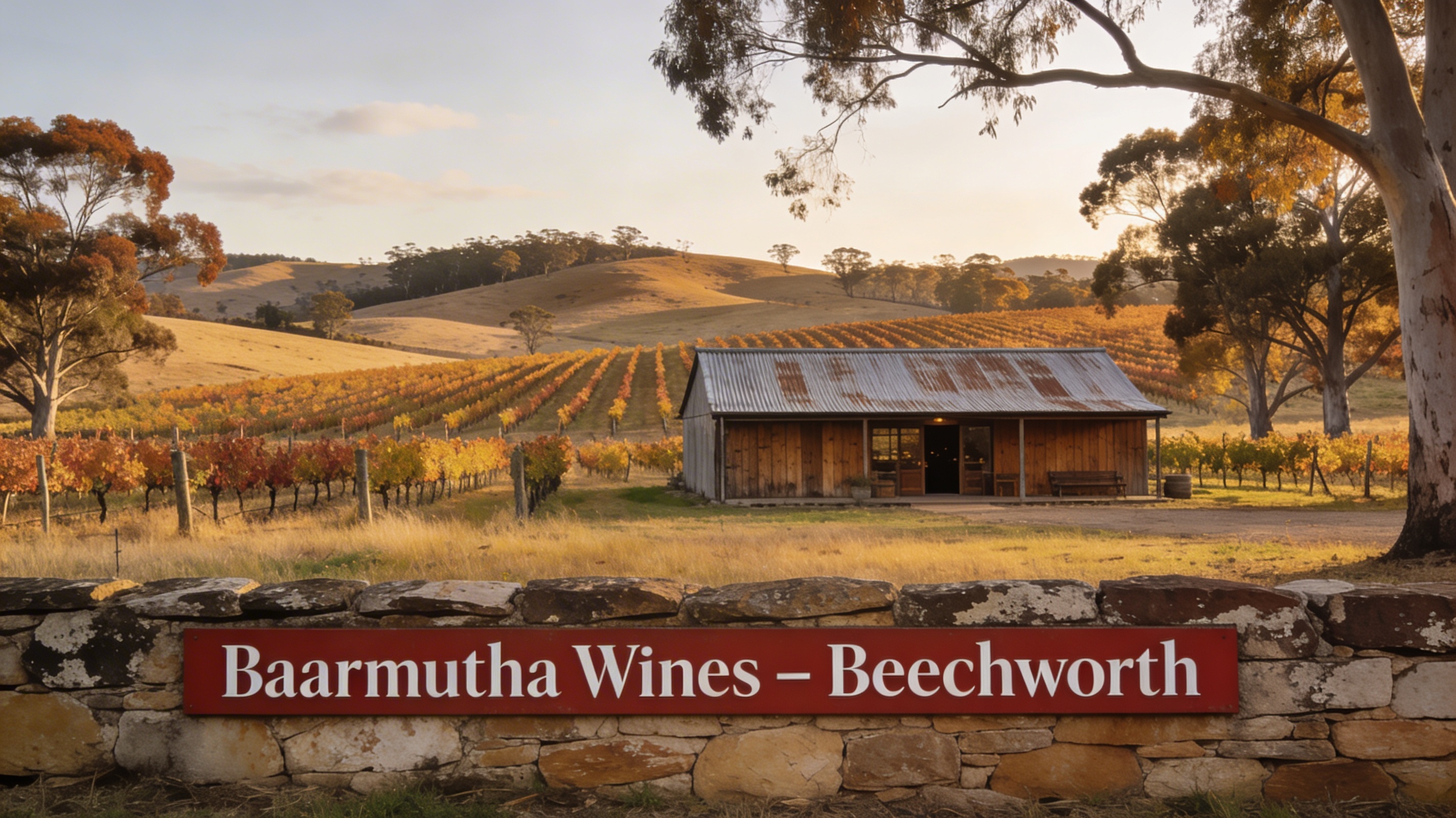
How a 45‑acre gamble became Baarmutha Wines
Baarmutha Wines did not begin as a neatly drafted business plan. It began with a leap of faith, a 45‑acre property just 6.5 kilometres from the Beechworth Post Office, and a couple prepared to learn every inch of the craft the hard way.
Around twenty years ago, Vinny and Sharon Webb bought this parcel of land in Victoria’s High Country, not yet imagining that it would become one of Beechworth’s most characterful small wineries. The first vines went into the ground in 2006, with the early ambition simply to make wine for family and friends. Very quickly, that modest project evolved into a full immersion in viticulture and oenology, with Vinny undertaking formal studies through Charles Sturt University and the couple building Baarmutha Wines from bare paddock to working vineyard and underground cellar.
Today, Baarmutha Wines is recognised as a boutique Beechworth estate focused on Chardonnay, Shiraz and a growing Italian thread led by Sangiovese and Sagrantino, all produced in small quantities and with a clear sense of place. It remains very much a family affair, built on hard physical work in the vineyard and a deliberately hands‑on, low‑intervention approach in the winery.
Meeting the people behind the bottles
The personality of Baarmutha Wines is impossible to separate from Vinny and Sharon Webb. Vinny is not just the winemaker; he is also the viticulturist, grower, host and storyteller for visitors who make the short drive out along Diffey Road. Sharon works alongside him, sharing the same mix of pragmatism and hospitality that has become part of the cellar‑door experience.
Their story is typical of Beechworth in one important way. Many of the region’s most interesting producers did not inherit grand châteaux; they built small, intensely personal projects from scratch, often while juggling studies, families and day jobs. Baarmutha Wines fits squarely into that tradition. The Webbs have been responsible for every stage of the process, from choosing rootstocks and clones to planting, hand‑weeding, mulching and harvesting with family and friends.
Visitors who book a tasting at Baarmutha Wines are not greeted by a polished corporate team. They meet the people who planted the vines, made the wine, and built the underground barrel room where tastings sometimes include comparative samples from multiple vintages still resting in oak. Reviews of the cellar‑door experience consistently mention Vinny’s easy manner, his willingness to explain decisions in the vineyard and winery, and the sense that guests are being invited into an ongoing project rather than a finished museum.
Beechworth’s high‑country patchwork, and why it suits Baarmutha
Beechworth has quietly become one of Victoria’s most respected cool‑climate regions, renowned far beyond its size for concentrated, finely structured Chardonnay, Shiraz and an increasingly adventurous cast of Italian and other European varieties. The town sits in north‑east Victoria, surrounded by rolling hills and at elevations that deliver warm, sunny days tempered by cool nights during the growing season.
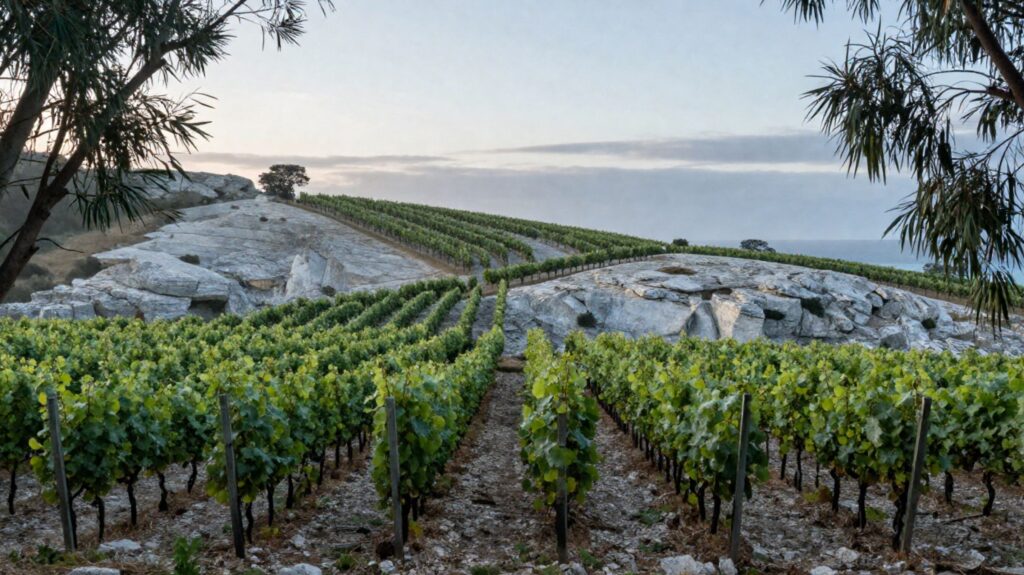
Here is where Baarmutha Wines finds its character. The Beechworth geology is famously complex, effectively split between old granite soils and red clay. Granite, described by one account as “like smashed glass and talcum powder dust in the summertime”, tends to give wines a distinct line of minerality and tension. Red clay, by contrast, encourages deeper rooting and generous fruit flavours.
Baarmutha Wines sits in this matrix of soil types and actively plays with it. The estate grows its own fruit on red clay at the property while sourcing parcels from granite‑based sites elsewhere in Beechworth. Vinny then trials blends that bring together the peppery, earthy edge of granite‑grown fruit with the more generous, plush characters from the home block. Only when the combination feels like a true celebration of Beechworth’s diversity does it make it into bottle.
The climate does the rest. Higher altitude and cooler nights hold back sugar accumulation, particularly important for Shiraz and Sangiovese, resulting in lighter‑bodied, fresher wines rather than the heavyweight styles associated with hotter regions. For Chardonnay, the retained acidity and gradual flavour development deliver precision, drive and ageing potential that Australian collectors increasingly expect from Beechworth.
Featured Wines
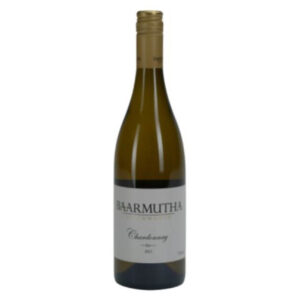
Baarmutha Wines Chardonnay 2024 (6 Bottles) Beechworth, VIC
Add to Cart
$46.67
/ bottle
$280.00 for a case of 6

Baarmutha Wines Sangiovese 2024 (6 Bottles) Beechworth, VIC
Add to Cart
$40.00
/ bottle
$240.00 for a case of 6
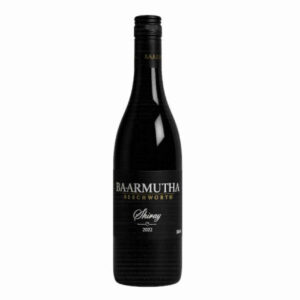
Baarmutha Wines Shiraz 2023 (6 Bottles) Beechworth, North East VIC
Add to Cart
$52.50
/ bottle
$315.00 for a case of 6
From vine to barrel: how the wines are made
Baarmutha Wines works at a scale where every row and barrel can be monitored closely. Vineyards are planted with relatively wide row spacing (around 3 metres) and vines at 1.5 metres, a configuration chosen deliberately to reduce disease pressure by allowing light and air into the canopy and to reduce competition between vines. Mulching, hand‑weeding and careful canopy management underpin the drive to bring in healthy, concentrated fruit rather than relying on aggressive winery corrections later.
In the winery, the philosophy leans towards Old World principles. Ferments are typically wild, relying on indigenous yeasts, and interventions are kept minimal. Time underground is an important part of the process, with wines resting in barrel in the purpose‑built space beneath the old Goldfields‑style building on the property. The emphasis is on texture and balance rather than obvious oak imprint, with the choice of barrel and length of maturation calibrated to each variety and vintage.
For Chardonnay, Baarmutha Wines seeks classic oak accents, including hints of vanilla, yet encourages full or partial malolactic conversion so that acidity softens from sharp green‑apple notes into something rounder and more layered. For readers looking to explore similar styles more broadly, it is easy to buy Chardonnay wine through specialist like Cellars.com.au who have 789 Chardonnay Wines available.
What is in the glass: the Baarmutha range
The core Baarmutha Wines range is relatively compact but thoughtfully assembled, and Sangiovese sits right at its heart.
Chardonnay is one of the clear pillars of Baarmutha Wines. The fruit, drawn from both estate and select Beechworth sites, typically shows citrus and stone‑fruit characters supported by brisk acidity and a thread of minerality derived from the region’s granitic influence. Barrel work and malolactic fermentation add layers rather than weight, creating an impression of richness without heaviness.
Shiraz from Baarmutha Wines is distinctively Beechworth. Cooler temperatures and careful picking decisions result in lighter body, fresh acidity and spice, rather than the full‑throttle, high‑alcohol profile of many warmer‑climate Australian examples. Aromas of black cherry, pepper and subtle oak tend to define the style, with an emphasis on savoury detail instead of simple sweetness.
Then there is Sangiovese, the variety that ties Baarmutha Wines directly to the hillsides of Tuscany whilst remaining unmistakably Beechworth in accent. In this high‑country setting, Sangiovese ripens with bright red‑cherry and wild‑berry aromas, lively acidity and gently powdery tannins. It is the kind of medium‑bodied red that feels as comfortable on a weekday dinner table as it does in a more serious tasting line‑up.
Why would Australian drinkers love this Sangiovese? Because it speaks fluently to local food culture. The natural acidity and savoury edge make it a brilliant partner for tomato‑based dishes, grilled meats, hard cheeses and anything involving olive oil and herbs. It is the opposite of jammy; it is energetic, food‑shaped and refreshingly dry.
Alongside Sangiovese sits Sagrantino, another Italian variety that brings deeper colour, more assertive tannins and a darker flavour spectrum. When handled sensitively, Sagrantino offers brooding black fruit, spice and a structural frame that rewards decanting and hearty food. Together, Sangiovese and Sagrantino give Baarmutha Wines an Italian thread that feels both distinctive and very much at home in Beechworth’s cool‑climate context.
Volumes are tiny. Production is still counted in hundreds of dozens rather than thousands, which means that each label is made in genuinely small quantities. For enthusiasts, this scarcity is part of the appeal. When a new vintage appears, it is not a mass‑market release; it is the next chapter of a continuing experiment in one specific corner of Beechworth.
Why these wines resonate with serious drinkers
What makes Baarmutha Wines compelling is not just that the wines are well made. Many Australian wines are. It is that the entire project feels anchored in a place and a set of values that speak clearly to today’s serious drinkers.
Firstly, there is the transparency of origin. Every decision, from vineyard spacing to the choice of Italian and classic varieties, has been shaped around Beechworth’s cool climate and complex soils. The wines taste like they come from high‑country Victoria rather than from a generic “Australian” template. For enthusiasts who seek character and nuance over volume and uniformity, that is crucial.
Secondly, there is the scale. With production still small enough that one person can oversee every vine and barrel, Baarmutha Wines exists in that rare space where attention to detail is not a slogan but a daily reality. This allows for flexibility and responsiveness across vintages that larger operations simply cannot match.
Finally, there is hospitality. The cellar‑door experience, with underground barrel tastings, salami made on site and the chance to walk through the vines with the people who tend them, turns an abstract brand into a tangible story. Visitors repeatedly describe Baarmutha Wines as one of Beechworth’s most engaging stops precisely because it feels unpolished in the best possible way: personal, curious and rooted in the realities of farming and winemaking.
For Australian drinkers, particularly those already comfortable with the language of terroir, clone selection and minimal intervention, Baarmutha Wines offers something refreshingly straightforward. This is not cult wine cloaked in mystery. It is a thoughtful, evolving family project that wears its history and its hard work quite openly.
For anyone who has ever wondered what happens when a 45‑acre dream, a cool‑climate hillside and a determination to do things properly all collide, Baarmutha Wines provides a beautifully drinkable answer, with Sangiovese right at the centre of the conversation.





 Shiraz
 Cabernet Sauvignon
 Pinot Noir
 Grenache
 Merlot
 Red Wine Blends
 Chardonnay
 Riesling
 Pinot Gris
 Semillon
 Viognier
 Grenache Rosé
 Pinot Noir Rosé
 Shiraz Rosé
 Sangiovese Rosé
 Aglianico Rosé
 Clairette Rose
 Champagne
 Prosecco
 Sparkling Shiraz
 Blanc de Blanc
 Blanc de Noir
 Pet Nat
 Moscato
 Topaque
 Port
Port Sherry (dry & sweet)
 Muscat & Tokay
 Vermouth