 0473 644 098 · Mon–Fri 9am–5pm AESTHelp & FAQ





“Organic” on a Wine Label Might Not Mean What You Think

By Luke, Cellars Wine Tester | Published 22 November 2026 | 9 min read
Some wines in this guide are sold on Cellars.com.au. I recommend them because they help you buy organic wine with confidence, not because we sell them.
Here’s a fact that surprises almost everyone I pour for. A wine sold in Australia can put the word “organic” on its label without being certified by anyone.
No inspector has to visit the vineyard. No auditor has to check the winery. The same bottle would need full certification to be exported overseas, but not to sit on a shelf in Sydney or Perth.
That doesn’t mean uncertified organic wine is fake. Plenty of small growers farm beautifully without paying for the paperwork. But it does mean the word alone isn’t a guarantee, and you deserve to know how to tell the difference.
The quick answer
-
The word isn’t regulated at home. Australia has no legal definition of “organic” for products sold here. Certification is voluntary.
-
The law still applies. A business can’t make a false or misleading organic claim, and it must be able to back the claim up if challenged.
-
Exports are stricter. Any wine exported with an organic claim must be certified to the National Standard, the government’s organic rulebook.
-
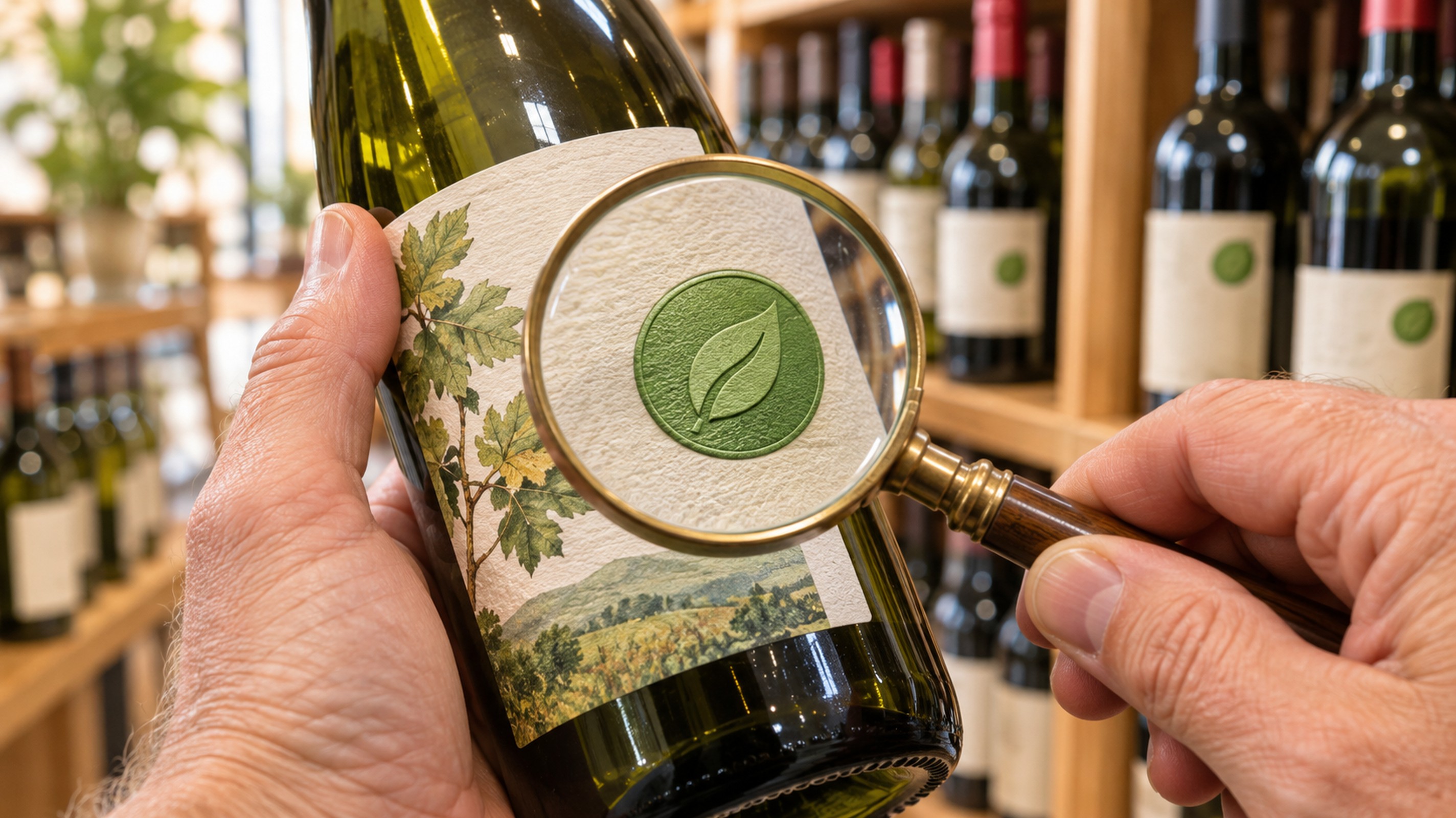
Look for a logo, not a word. A certifier’s mark and certification number is the only quick proof the claim has been independently checked.
-
Organic isn’t vegan, sulphite-free or “natural”. Those are separate things, and the label rules for each are different again.
Wait, how is this allowed?
Australia’s organic system grew up around exports. Overseas buyers in Europe, the US and Asia demanded proof, so the government built a strict National Standard for anything leaving the country.
For the home market, though, there’s only a voluntary standard. The broad rules against misleading claims in Australian Consumer Law are the main safety net. But consumer regulators have said themselves that chasing dodgy organic claims is hard when the law doesn’t define what organic means.
Industry groups say Australia is the only developed OECD country without a legislated national framework for organic claims. The organic industry is now consulting on a fix, and I’ll come back to that at the end.
Why shoppers are getting caught out
This isn’t a theoretical problem. Industry research this year found that around a third of recent organic buyers believe they’ve been misled by something labelled organic that turned out not to be. Of those, more than four in five said it made them doubt other organic products too.
Earlier government research found something even more telling. Around 30% of shoppers picked a completely made-up logo as proof that a product was organic. A green leaf and a confident font go a long way.
And about $100 million a year of Australian organic grocery spending goes on products presented as organic but not certified. Some of those will be perfectly genuine. The point is, you can’t tell which.
Jackie Brian, CEO of Australian Organic Limited, the peak body for the certified organic sector, put it simply. “Australians have a right to purchase products with confidence that the label tells the truth.”
What certified organic wine actually involves
When a wine is properly certified, it’s a serious commitment. Here’s what sits behind the logo.
In the vineyard
Certified growers can’t use synthetic herbicides, synthetic pesticides or synthetic fertilisers. Instead, they manage weeds with mowing, grazing animals or cover crops, which are plants sown between the vine rows to build soil health and attract helpful insects.
Converting a vineyard takes time. The land has to be farmed organically for a set period, with records and audits, before the grapes can be sold as certified organic. Until then, you may see the words “in conversion” on the label.
In the winery
Under the National Standard, certified organic wine has to be made entirely from organic grapes, using only approved additives and processing aids. Some common winemaking shortcuts are off the table. For example, organic wine can’t be partially dealcoholised, and filtration can’t be ultra-fine.
Sulphur dioxide, the most common wine preservative, is still allowed, but at lower limits. A dry certified organic red can contain up to 100 milligrams per litre, compared with up to 250 for a conventional dry wine under Australia’s food rules.
On paper
Certified producers keep detailed records and are audited, usually every year. That paper trail is what lets a certifier vouch for the claim on the bottle.
The logos worth looking for
These are the marks you’ll most often see on certified organic or biodynamic Australian wine. Each one should come with a certification number nearby.
-
ACO (Australian Certified Organic). The green “bud” logo. It’s the most common organic mark on Australian wine.
-
SXC (Southern Cross Certified). A major wine certifier, approved for organic exports to the UK, EU, US and Canada.
-
OFC (Organic Food Chain). Another government-approved certifier.
-
Demeter, from the Bio-Dynamic Research Institute. This is the mark for certified biodynamic wine.
-
NASAA Certified Organic. You’ll still see this logo on older bottles. NASAA withdrew from National Standard certification in mid-2025, so producers it certified have moved to other certifiers, and newer releases should carry their new certifier’s mark.
Imported wine may carry overseas marks instead. The EU’s green leaf and the USDA Organic seal are the ones you’ll see most.
Label decoder
Here’s what the common eco-friendly words on wine labels actually tell you in Australia.
| What the label says | What it means here | Independently checked? |
|---|---|---|
| “Certified organic” with a certifier logo and number | Grapes and winemaking meet an organic standard, audited by a certifier | Yes |
| “Organic” with no logo | The producer says it’s organic. It may be genuine, but nobody has to check | Not necessarily |
| “Made with organic grapes” | The grapes are claimed to be organic. Winemaking may not follow organic rules | Not necessarily |
| “In conversion to organic” | The vineyard is part-way through the conversion period | Yes, if a certifier is named |
| “Biodynamic” with a Demeter logo | Organic farming plus biodynamic practices, certified | Yes |
| “Vegan” or “vegan friendly” | No animal-derived products used in fining. Separate from organic | Only if a vegan certifier is named |
| “Natural” or “minimal intervention” | A winemaking philosophy. There’s no legal definition at all | No |
| “Sustainable” with a Sustainable Winegrowing Australia mark | The business is certified under the national sustainability program | Yes |
| “Sustainable” with no mark | A general claim about the producer’s practices | No |
Five things organic doesn’t mean
This is where the myths creep in. Let’s clear them out.
Myth: Organic wine has no sulphites.
Science: Yeast naturally makes small amounts of sulphites during fermentation, so no wine is completely sulphite-free. Certified organic wine can also have sulphur dioxide added, just at lower limits. If a wine contains 10 milligrams per kilogram or more of added sulphites, the label must say so, usually as “preservative 220” or “contains sulphites”.
Myth: Organic wine is automatically vegan.
Science: Certified organic wine can still be fined with egg white, milk protein, gelatin or isinglass, which comes from fish. Fining is a step where a substance is added to bind with haze-causing particles so they drop out of the wine. If you want vegan, look for a vegan claim as well as an organic one.
Myth: Organic grapes are grown without any sprays.
Science: Organic growers can still spray, but only with approved products. The most common are copper and sulphur, used against fungal diseases like downy and powdery mildew. They’re old-school tools, and copper in particular needs careful management because it builds up in soil.
Myth: Organic means natural wine.
Science: Natural wine is a style, usually made with wild yeast, little or no added sulphur and minimal filtering. Some natural wines are certified organic, and plenty aren’t. Many certified organic wines are made in a perfectly classic, polished style.
Myth: Organic wine always tastes better.
Science: Organic farming changes how a vineyard is managed, not the basic chemistry of how wine tastes. Many growers say the extra attention in the vineyard shows in the glass, and some of Australia’s top wines are organic. But a well-made conventional wine will beat a poorly made organic one every time. Taste is still down to the site, the season and the winemaker.
How to buy organic wine you can trust
You don’t need a law degree to get this right. A 10-second check on the label does the job.
-
Find the logo. Look on the back label for a certifier mark such as ACO, SXC, OFC or Demeter.
-
Find the number. Real certification comes with a certification number. A logo with no number deserves a second look.
-
Read the exact wording. “Certified organic wine” and “made with organic grapes” aren’t the same claim.
-
Check the vintage. Certification is renewed each year, so if a producer has recently converted, older vintages may not be certified.
-
Look it up if unsure. Certifiers publish searchable lists of their certified operators on their websites.
-
Ask the producer. Genuine uncertified organic growers are usually happy to tell you exactly how they farm, and why they haven’t certified.
If you can name the certifier on the bottle, or you’re happy trusting the producer without one, you’re good to go.
Pick your bottle by what matters to you
Different shoppers want different things from an eco-friendly label. Here’s where to start.
| What you care about | Pick this | What to check on the label |
|---|---|---|
| Grapes grown without synthetic chemicals | Certified organic wine | A certifier logo and number |
| No animal-derived fining | Vegan friendly wine | A vegan claim or certification |
| Organic and vegan together | Certified organic wine | Both a certifier mark and a vegan claim |
| A wild, low-intervention style with bubbles | Pet nat | Whether the producer also lists certification |
| A mixed taste test of organic styles | Mixed cases | The certification on each individual bottle |
If you want to go deeper on where organic, biodynamic and vegan wines fit into the bigger picture, read Vegan Friendly, Organic, Biodynamic.
Could the rules change?
Possibly, but not quickly. Australian Organic Limited is running a national consultation through November and December 2026. It’s proposing a binding rule under Australian Consumer Law that would link any organic claim to the National Standard, much like the rules that already give legal meaning to “free range” on eggs.
The federal government has agreed in principle to keep working on reform with industry and the states. It hasn’t committed to a model or a start date, and any change would need further government consultation first.
Jackie Brian summed up the industry’s case. “Clear rules would protect shoppers and back the farmers and businesses who do the work to earn the organic label.”
Until then, the logo is your friend.
FAQs
Does organic wine have to be certified in Australia?
No. Wine sold within Australia can be labelled organic without certification, as long as the claim isn’t false or misleading and the producer can back it up. Wine exported with an organic claim must be certified to the National Standard.
How can I tell if a wine is really organic?
Look for a certifier logo such as ACO, SXC, OFC or Demeter, together with a certification number. Without those, the organic claim hasn’t necessarily been independently checked, even if it’s genuine.
Is organic wine preservative free?
Usually not. Certified organic wine can contain added sulphur dioxide, though at lower maximum levels than conventional wine. Yeast also creates small amounts of sulphites naturally during fermentation.
What is the difference between organic and biodynamic wine?
Biodynamic farming starts with organic principles, then adds extra practices like herbal and mineral preparations and a planting calendar linked to lunar cycles. In Australia, certified biodynamic wine usually carries the Demeter mark.
Is organic wine vegan?
Not always. Certified organic wine can still be fined with animal-derived products like egg white, milk protein or isinglass. Look for a separate vegan claim if that matters to you.
What does “made with organic grapes” mean?
It means the grapes are said to be organic, but the winemaking may not follow organic rules. On an export label, this wording counts as an organic claim and must be certified. On a domestic label, it may not be.
 Shiraz
 Cabernet Sauvignon
 Pinot Noir
 Grenache
 Merlot
 Red Wine Blends
 Chardonnay
 Riesling
 Pinot Gris
 Semillon
 Viognier
 Grenache Rosé
 Pinot Noir Rosé
 Shiraz Rosé
 Sangiovese Rosé
 Aglianico Rosé
 Clairette Rose
 Champagne
 Prosecco
 Sparkling Shiraz
 Blanc de Blanc
 Blanc de Noir
 Pet Nat
 Moscato
 Topaque
 Port
 Sherry (dry & sweet)
 Muscat & Tokay
 Vermouth
