 0473 644 098 · Mon–Fri 9am–5pm AESTHelp & FAQ





A Barossa Aglianico Won Best in Show. Should Shiraz Drinkers Try It?

By Kurt, In-House Wine Tester | Published 25 November 2026 | 8 min read
Some wines in this guide are sold on Cellars.com.au. I recommend them because they work with this comparison of Aglianico and Shiraz, not because we sell them.
A Barossa red took the top trophy at this month’s Australian Alternative Varieties Wine Show in Mildura. It was Purple Hands’ 2024 Aglianico, a wine made from a southern Italian grape. If you like Shiraz for its weight but sometimes wish it had a sharper edge with dinner, Aglianico is worth a look. Don’t buy it expecting a softer version of the red you already pour.
Start with why you like Shiraz
Some people open a Barossa Shiraz for the plush blackberry fruit and the way it fills the mouth. Others want a red with enough substance to hold up to the char on a lamb chop. Those are different reasons to pick the same bottle, and only the second is a straightforward reason to swap it for Aglianico.
Both grapes can give you a substantial red with dark fruit and spice. But the quickest way to understand Aglianico is to pay attention after you swallow. The first taste might be all dark cherry or plum. Then comes a drying grip along your gums and a tartness that keeps the finish from feeling broad or sweet. That contrast is the appeal, especially if you’ve got another bite of dinner waiting.
Tannin is what makes the inside of your mouth feel dry. Compounds from the grape, especially its skins and seeds, interact with proteins in your saliva, making the mouth feel less slippery. It’s the sort of grip you get from strong black tea. Acidity is a different sensation. Think of the mouth-watering tang of biting into a just-ripe plum. Aglianico can give you both at once.
Shiraz can be grippy and savoury, too. The comparison here is with a plush, fruit-forward style, not every Shiraz made in Australia. Anyone who already enjoys a firmer Shiraz may find the change less dramatic. What I wouldn’t do is buy Aglianico to solve a problem I don’t have. When I want a generous red to sip on its own, a supple Shiraz is still the better choice.
“Full-bodied” won’t help you much at this point. It tells you how substantial the wine might feel, not whether it will finish silky or leave your gums dry. Look for words like chewy, firm or grippy in a tasting note. Those tell you more about whether it’s the sort of red you want to pour before the plates arrive.
Why this grape makes sense in South Australia
Aglianico comes from southern Italy. It ripens late, so it needs enough warmth and time to get there, but it can hold on to acidity through a long growing season. That combination makes it worth trying in warm Australian sites. It means a grower can aim for ripe fruit without necessarily losing the freshness that makes this red useful at the table.
Late ripening doesn’t mean late harvest in the sense of a sweet wine. It’s about when the grapes are ready to pick. For this style, the grower wants more than enough sugar to ferment. The fruit and skins need to reach a point where the wine can be firm without feeling green. That’s part of the challenge of growing a grape whose structure is hard to hide.
Its small berries and thick skins can also help explain the colour and grip. More skin relative to the amount of juice gives the winemaker plenty to work with. The amount they actually draw into the wine depends on choices such as time on skins. A deep colour is not a reliable measure of how hard the wine will pull on your gums, and there’s no requirement to make the biggest red the grape can produce.
The Purple Hands wine took Best Red Wine and Best Italian Variety Wine as well as Best Wine of Show. That’s a result for the 2024 release at this particular show, not a head-to-head win over Barossa Shiraz. The worthwhile takeaway is that the Barossa can make a convincing red in a register other than the one it’s famous for. You don’t have to prefer it to Shiraz to want both in the rack.
Let dinner make the case
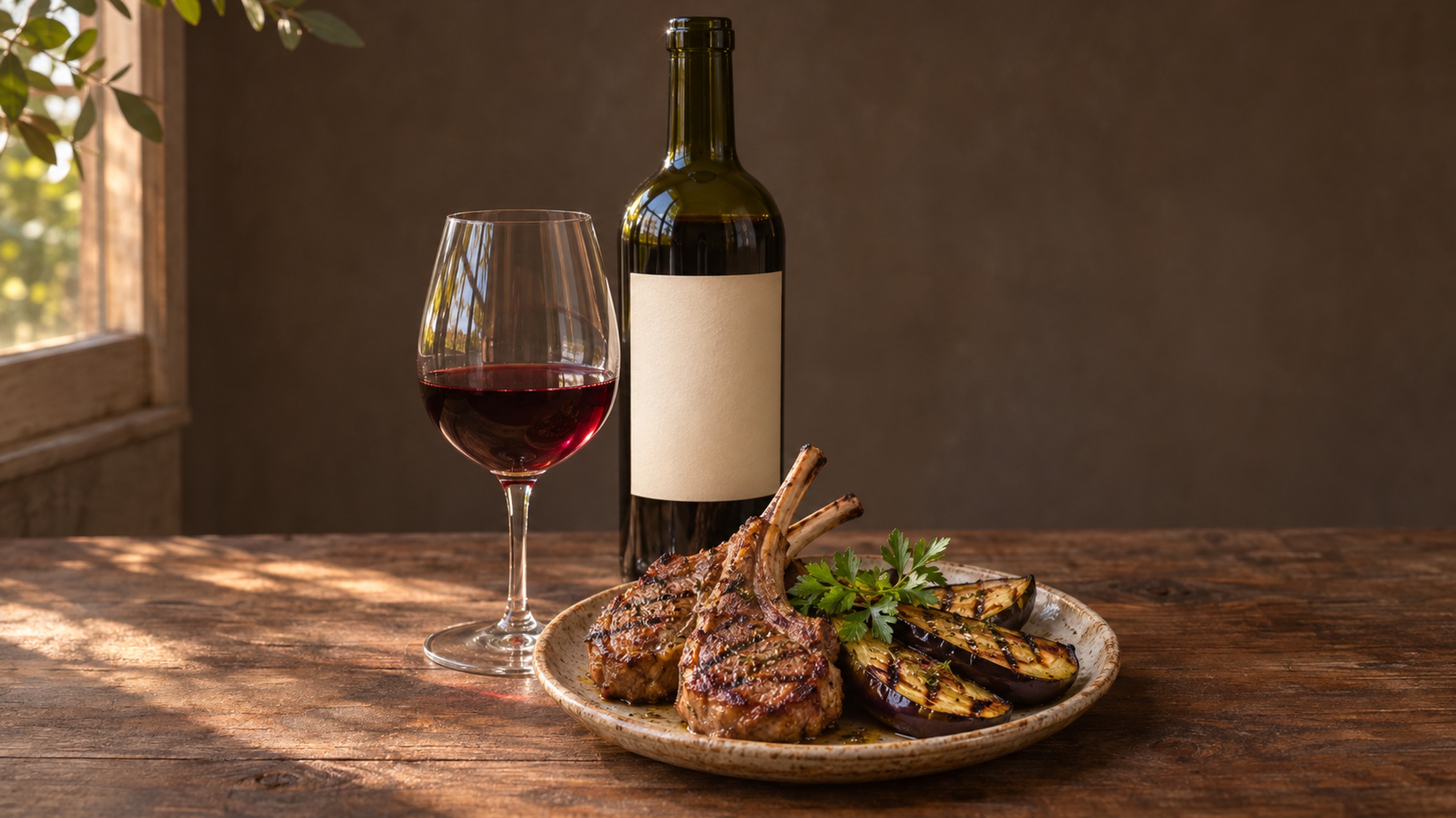
I’d put a firm Aglianico with lamb cutlets grilled until their edges brown, not because the wine needs the most expensive thing on the plate, but because the savoury crust is a good match for the wine’s grip. Leave the sticky bottled glaze in the fridge. A sweet glaze can make a dry, tannic red seem harsher. Olive oil, salt and rosemary are enough here.
Eggplant can do the same job without the meat. Give it time to brown properly rather than pulling it off the grill while the centre is still spongy. Serve it with olive oil and a spoonful of lentils, or bake it with tomato and parmesan. It’s the browned edges and the richness from the oil or cheese that give the wine something to work with.
| What’s for dinner | What I’d pour | Why it fits |
|---|---|---|
| Slow-roasted lamb shoulder or mushroom pie | Firm Australian Aglianico | A drying finish and lively acidity keep pace with the richness |
| Sausages with sticky onion relish | Plush, fruit-forward Shiraz | A softer finish is a better fit for the sweet relish |
| Tomato and sausage ragù | Campanian Aglianico | The acidity stands up to the tomato without losing the wine’s savoury edge |
For a quick test, pour a small taste of Aglianico before dinner, then go back to it after a bite of hard cheese. A plain, salty pecorino is a useful starting point. See whether the grip bothers you less and whether the fruit is easier to find. You’re not trying to fix a wine you dislike. You’re finding out whether the thing that seemed severe on its own is the thing you enjoy with food.
The pairing I’d avoid is a hot chilli sauce with a particularly forceful bottle. The sauce can dominate the fruit while the drying finish still gets through. A little chilli in a ragù is one thing. If the hot sauce is the main flavour, save the firm red for another dinner rather than buying it because its name sounds right for the menu.
Which bottle makes the best introduction?
The Hither & Yon Aglianico 2023 from McLaren Vale is where I’d start for the firmer style. The tasting notes on the producer’s site point to dark fruit, sour cherry and herbs. Those are good clues for someone looking for a red that leans savoury without leaving the fruit behind. Buy it for the dinner you’ve planned, rather than hoping the grip will go unnoticed.
The Ricca Terra Aglianico 2025 from the Riverland is a useful option if you’re coming from a riper red. The published notes describe generous dark fruit alongside firm tannin and fresh acidity. It’s not the choice for someone trying to avoid tannin altogether. It’s the one I’d look at if I wanted to keep the fruit weight familiar and change the shape of the finish.
There’s a gentler Australian option in the Mac Forbes EB87 Aglianico 2023. Cellars lists it as a juicy Riverland red with softer tannins. That’s worth noticing next to the Ricca Terra from the same region. The place and the grape give you a starting point, but neither tells you how much grip the winemaker chose to leave in the finished wine.
For an Italian reference, look at Villa Raiano Aglianico Campania 2023. It gives you a southern Italian example without making your first purchase a Taurasi, the more specific Campanian appellation. An Italian bottle is useful as a point of comparison, not as the answer key for what the Australian wines should taste like. Try it because you’re curious about another expression of the same grape.
None of those is the trophy winner. If you want the Purple Hands specifically, check both the producer and the year before buying. A listing for the 2023 does not inherit the 2024’s result. And if your first taste of Aglianico would involve committing to a full case, a glass with dinner or a single bottle is a better place to start. The main question is whether you like its finish, not whether you can get the trophy vintage.
Don’t rush to put it in the cellar
A firm young wine isn’t automatically an unfinished one. With food, the grip can be exactly what you bought it for. Taste it first. If it’s tight and you can barely smell the fruit, pour it into a decanter while you get dinner ready, then taste it again. Air can change what you smell. It won’t turn a structured red into a soft one.
Some Aglianico is built to develop over years, but tannin alone is a poor reason to put a bottle away. I’d look for fruit that still holds its own on the finish, plus a drinking window for the specific bottling. Our guide to deciding what to cellar and what to open now goes into that choice in more detail.
Use the same sort of glass you’d use for Shiraz. If you’re comparing the two, serve them at the same temperature. A warm Shiraz beside an Aglianico fresh from the fridge tells you very little about the grapes.
For a first bottle, skip the long-range plan. Pour it with dinner. A red that works with the browned edge of the lamb has already done its job.
Questions about Aglianico
How do you pronounce Aglianico?
A rough English guide is ahl-YAH-nee-koh. The emphasis is on the second syllable. The Italian sound represented by gli is softer than a hard English g.
Is Aglianico the same thing as Taurasi?
Aglianico is the grape, while Taurasi is a protected wine name from Campania. Taurasi must contain at least 85 per cent Aglianico. Not every bottle labelled Aglianico comes from Taurasi.
What is Aglianico del Vulture?
It’s a protected wine name from the Vulture area of Basilicata in southern Italy. It’s made from Aglianico, but the name identifies where the wine comes from rather than another grape variety.
Should Aglianico be served at room temperature?
Not if the room is hot. Start a fuller example slightly cool, around 16 to 18 degrees Celsius, and let it warm a little in the glass. A warm kitchen bench in an Australian summer isn’t a serving guide.
Does Aglianico always taste oaky?
No. Oak is a winemaking choice, not a feature every bottle shares. If you’re looking for fruit and savoury grip without much oak flavour, check the producer’s notes for how the wine was matured, not just whether a barrel is mentioned.
 Shiraz
 Cabernet Sauvignon
 Pinot Noir
 Grenache
 Merlot
 Red Wine Blends
 Chardonnay
 Riesling
 Pinot Gris
 Semillon
 Viognier
 Grenache Rosé
 Pinot Noir Rosé
 Shiraz Rosé
 Sangiovese Rosé
 Aglianico Rosé
 Clairette Rose
 Champagne
 Prosecco
 Sparkling Shiraz
 Blanc de Blanc
 Blanc de Noir
 Pet Nat
 Moscato
 Topaque
 Port
 Sherry (dry & sweet)
 Muscat & Tokay
 Vermouth
